A practical guide for traders who want to automate their strategies — from a CFD trader who actually uses them.
Imagine your trading strategy running 24 hours a day, five days a week, without fatigue, emotion, or distraction. That’s the core promise of algotrading — and it’s no longer reserved for hedge funds or Wall Street institutions. Today, retail traders on platforms like Exness, OANDA, and IG can deploy automated systems with a few clicks. But before you hand over your capital to a robot, you need to understand exactly what these tools are, what they can and cannot do, and how to use them safely.
What Is Algotrading? Understanding Trading Robots
Algotrading (short for algorithmic trading) refers to the use of software programs — commonly called trading robots, automated trading systems, or Expert Advisors (EAs) — that open and close trades based on pre-defined rules coded by a developer or trader.
These robots do not “think” in the human sense. They operate on mathematical probability models built from historical market data. A developer typically backtests a strategy against years of price data to verify whether the logic would have been profitable before deploying it in live markets.
It’s worth clarifying a common misconception: most retail trading robots do not use Artificial Intelligence or Machine Learning. They run on conventional programming logic — “if price crosses this moving average, buy; if it drops below this level, close the trade.” AI-powered trading does exist, but it’s predominantly used by large financial institutions with significant R&D budgets. For the average retail trader, the robots available are rule-based systems, and that’s perfectly fine — rules-based systems can be highly effective.
Today, it’s estimated that over 70% of all trades executed on major financial exchanges are driven by automated systems. Algotrading is not a fringe concept — it is the dominant force in modern markets.
How Trading Robots Actually Work
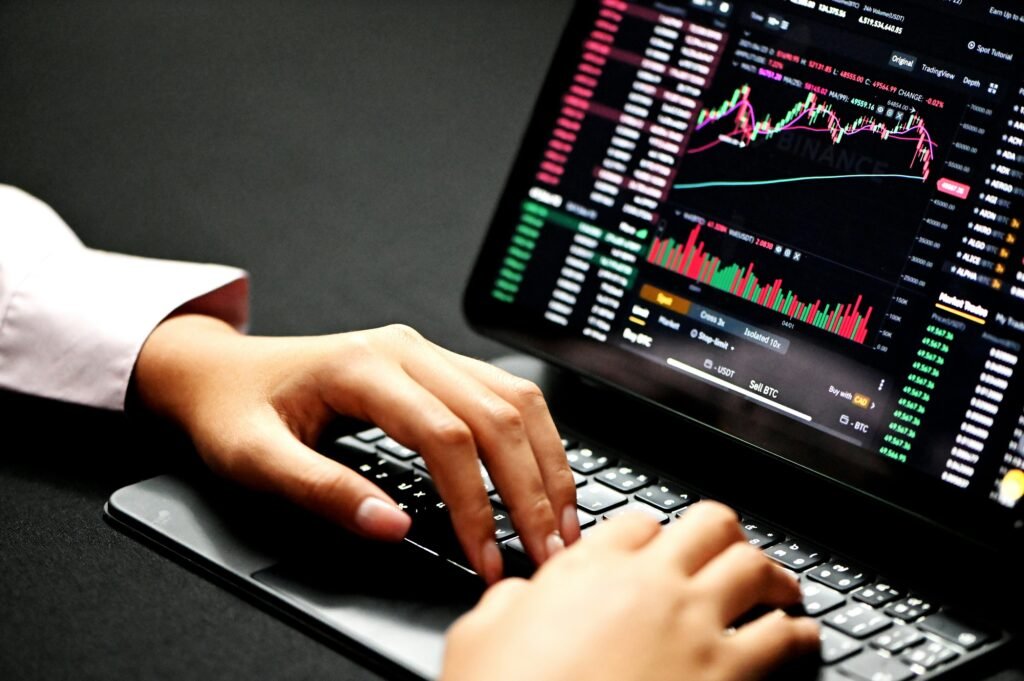
At their core, trading robots monitor market conditions continuously and react when specific criteria are met. Here’s the typical workflow:
1. Signal Detection — The robot scans price data, indicators (moving averages, RSI, Bollinger Bands, etc.), and sometimes volume or news feeds every second across multiple assets simultaneously. No human trader can replicate this speed or breadth of analysis.
2. Decision Execution — When conditions match the programmed rules, the robot places a trade automatically, including entry price, stop-loss, take-profit, and position size. Execution happens in milliseconds — far faster than any manual input.
3. Trade Management — The robot monitors open positions and manages them according to its logic: trailing stops, partial closes, or adding to positions.
4. Exit — The trade is closed when the exit conditions are met, whether that’s hitting a profit target, a stop-loss, or an end-of-day rule.
Most CFD platforms that support algotrading — including Exness, OANDA, IG, and Forex.com — run Expert Advisors through MetaTrader 4 or MetaTrader 5 (MT4/MT5), the industry-standard platforms for automated retail trading. Exness, in particular, offers excellent MT4/MT5 integration with low latency execution, which is critical for algorithmic strategies.
The Real Advantages of Algotrading
Having run automated systems across multiple live accounts, the advantages are tangible and significant:
No Emotional Interference This is the biggest edge. Fear and greed destroy more trading accounts than bad strategies. A robot executes its rules regardless of whether the market “feels” scary or euphoric. It doesn’t freeze before pulling the trigger. It doesn’t revenge-trade after a loss. Every decision is mathematical.
24/5 Market Coverage Forex and CFD markets run continuously from Sunday evening to Friday night. A human trader sleeps; a robot doesn’t. Opportunities in the Asian session, news-driven spikes at 2am — a properly deployed EA captures all of them.
Multi-Asset, Multi-Indicator Analysis at Scale A single robot can monitor dozens of currency pairs, indices, and commodities simultaneously, applying complex multi-indicator logic to each one every second. This analytical capacity is simply impossible for a human trader.
Speed of Execution In fast-moving markets — around economic news releases, for example — the difference between a profitable entry and a missed trade can be milliseconds. Algorithmic execution eliminates human reaction time from the equation.
Accessibility for Non-Full-Time Traders This is arguably algotrading’s most democratizing quality. You don’t need to be glued to a screen all day. A well-configured system can manage your positions while you’re at work, sleeping, or living your life. Platforms like eToro have taken this concept even further with copytrading, where you can automatically copy the trades of proven human traders — a form of social algotrading.
The Honest Disadvantages You Need to Know
No tool is without limitations. Responsible traders understand these clearly before automating:
Blindness to Real-World Events A trading robot sees only what’s inside the chart. If a company’s CEO dies unexpectedly, if a central bank makes a surprise announcement, if a geopolitical crisis erupts — human traders immediately process the implications. The robot does not. It will continue following its rules even when market context has fundamentally changed. This is perhaps the most important limitation of rules-based algotrading.
Code Failures and Bugs A robot behaves exactly as it was programmed — which is a problem if the programming contains errors. A misplaced decimal in a position-sizing formula, a logic error in the exit conditions, or an untested edge case in market behavior can cause significant losses before the trader notices. This is why backtesting and demo trading are non-negotiable steps before going live.
Technology Dependencies Trading robots require stable internet connectivity, reliable hosting, and platform uptime. A dropped connection during an open trade, a broker server outage, or a computer restart can leave positions unmanaged at critical moments. This is precisely why serious algorithmic traders use a Virtual Private Server (VPS) hosted close to their broker’s servers — minimizing latency and ensuring 24/5 uptime regardless of what happens to their personal internet connection.
Over-Optimization Risk A robot can be backtested to perform perfectly on historical data — a trap called “curve fitting” — but fail completely in live markets because it was optimized for past conditions that no longer exist. Always validate a strategy on out-of-sample data before trusting it with real capital.
How to Use a Trading Robot Safely: A Step-by-Step Approach
Whether you’re building your own EA or purchasing one, follow this sequence:
Step 1 — Backtest Thoroughly Run the robot against at least 2-5 years of historical data on your chosen platform. Examine not just profitability but drawdown, win rate, risk-to-reward ratio, and performance across different market conditions (trending vs. ranging markets).
Step 2 — Forward Test on a Demo Account Run the robot in real-time market conditions on a demo account for a minimum of 4-8 weeks. This catches issues that backtests miss: slippage, spread variations, weekend gaps. Exness offers free demo accounts with real market conditions — ideal for this stage.
Step 3 — Deploy on Live with Minimal Capital Start with a small allocation — never your full trading capital. Monitor closely for the first few weeks. Compare live performance against your backtest expectations.
Step 4 — Set Up a VPS For serious deployment, run your MT4/MT5 and EA on a VPS hosted close to your broker’s servers. This ensures your robot stays connected and executing 24/5 without depending on your personal hardware or internet connection.
Step 5 — Monitor and Review Regularly Algotrading is not “set and forget.” Market regimes change. A strategy that worked well in a trending market may underperform during consolidation. Review performance monthly and be prepared to pause or adjust the system when conditions shift.
Algotrading Across Major CFD Platforms
Different platforms offer varying levels of support for automated trading:
Exness — Full MT4/MT5 support, ultra-low latency execution, competitive spreads. One of the most EA-friendly brokers available, particularly for scalping algorithms.
OANDA — Offers its own proprietary API in addition to MT4, making it popular with developers who want to build custom algorithms beyond the standard EA framework.
IG — Supports MT4 and has its own ProRealTime platform with backtesting capabilities. Strong regulatory standing and deep liquidity, important for larger automated strategies.
Forex.com — MT4 support with API access. Good for traders who want flexibility in how they connect their algorithms to the market.
Darwinex — Unique proposition: they allow traders to publish their automated strategies as investable DARWINs, where other investors can allocate capital. If your EA performs well, it can attract external capital, turning your algorithm into a scalable business.
eToro — While not a traditional algotrading platform, eToro’s CopyTrader feature functions as a social automated system. You select traders to copy and their trades are automatically replicated in your account proportionally.
Pros and Cons at a Glance
| ✅ Eliminates emotional trading | ❌ Cannot interpret real-world news events |
| ✅ Operates 24/5 without fatigue | ❌ Vulnerable to code bugs and errors |
| ✅ Executes at machine speed | ❌ Requires stable internet / VPS |
| ✅ Analyzes multiple assets simultaneously | ❌ Risk of over-optimization on historical data |
| ✅ Accessible for non-full-time traders | ❌ Strategy decay — markets change over time |
Start Automating With a Trusted Broker
If you’re ready to explore algotrading with a broker that supports it properly, Exness offers one of the most EA-friendly environments available — with full MT4/MT5 integration, competitive spreads, and reliable execution that algorithmic strategies depend on.
👉 Open your Exness account and start your algotrading journey
Frequently Asked Questions About Algotrading
Are trading robots actually profitable? Yes — when built on sound logic, properly backtested, and deployed responsibly. The majority of institutional trading volume globally is executed by algorithms. That said, profitability depends entirely on the quality of the underlying strategy. A poorly designed robot will lose money just as consistently as a poor manual trader.
Do trading robots use AI or Machine Learning? Most retail trading robots do not. The vast majority run on conventional rule-based programming logic. AI and Machine Learning applications in trading exist but are predominantly used by institutional players with significant technology resources.
Can a trading robot “go rogue” and behave unpredictably? In the dramatic Hollywood sense — no. Robots do exactly what they are programmed to do. However, bugs in the code, unexpected market conditions, or technology failures (connectivity issues, platform outages) can cause behavior that diverges from expectations. This is why thorough testing and VPS deployment are essential.
What’s the difference between an Expert Advisor and copytrading? An Expert Advisor (EA) is an automated system executing a coded strategy on your own account. Copytrading (available on platforms like eToro and Darwinex) automatically replicates the trades of another human trader in your account. Both are forms of automated trading, but an EA follows mathematical rules while copytrading follows a human trader’s decisions.
How much capital do I need to start algotrading? It depends on the broker and strategy. Exness allows trading with relatively modest minimums, making it accessible for beginners testing automated strategies. More important than capital size is starting with a demo account and only risking money you can afford to lose during the learning phase.
Risk Warning
Trading CFDs and forex involves significant risk of loss and is not suitable for all investors. Automated trading systems do not eliminate risk — they execute strategies that can lose money. Past performance of any trading robot or strategy, including backtested results, is not a reliable indicator of future results. You should never invest money you cannot afford to lose. Ensure you fully understand the risks involved and seek independent financial advice if necessary. This article contains affiliate links. The author may receive compensation when you open an account through links provided.